Updated: August 26, 2026
Author: Wisdom Emori
Football analysis becomes more reliable when decisions are based less on emotion or club reputation and more on measurable match data.
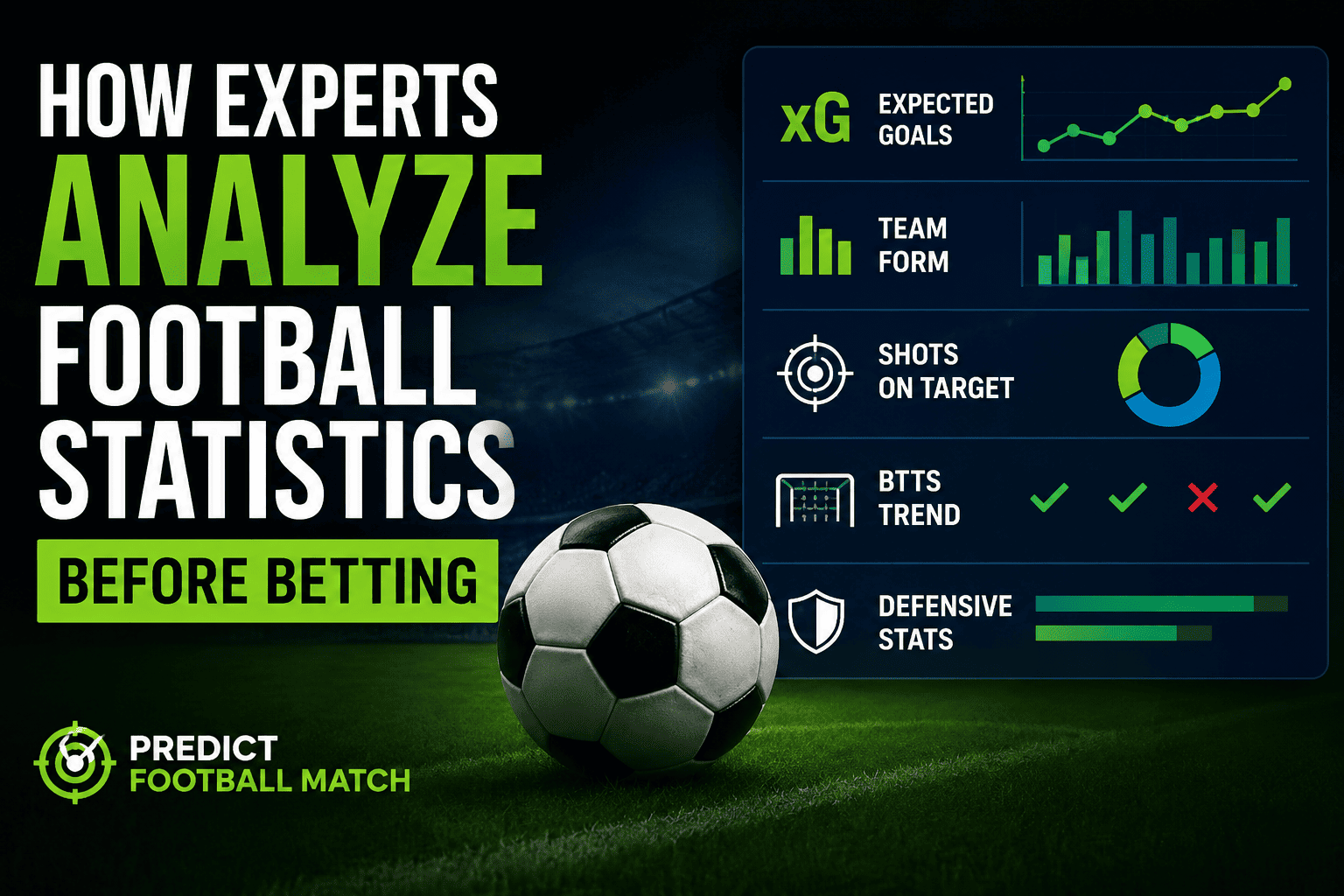
Instead of relying only on recent headlines or favourite teams, structured football analysis looks at patterns such as team form, goals scored and conceded, expected goals, shots on target, home and away performance, injuries, motivation, and overall match context.
If you want current match analysis and daily selections, you can also explore our Football Predictions Today page.
Why Football Statistics Matter Before Betting
Football statistics help reduce emotional decision-making and provide a clearer picture of how teams are actually performing.
They can help to:
- Reveal attacking and defensive patterns
- Identify changes in recent form
- Compare home and away performance
- Highlight teams creating or conceding frequent chances
- Support more structured market selection
This is one reason some bettors prefer higher-confidence selections such as our Banker Tips Today, where multiple statistical indicators are considered before a match is selected.
The Most Important Football Statistics to Analyse
Team Form
Recent form is one of the most useful starting points when analysing a football match.
Instead of looking only at league position, consider:
- Last 5 to 10 matches
- Win, draw, and loss patterns
- Goals scored recently
- Goals conceded
- Home and away records
- Quality of recent opposition
A team may sit high in the league table but still struggle consistently away from home. Likewise, a lower-ranked team may be performing strongly at home.
For matches where covering two possible outcomes may be preferable, you can explore our Double Chance Tips Today.
Goals Scored and Conceded
Goals statistics help identify attacking strength and defensive vulnerability.
Rather than looking only at a team’s average goals, compare:
- Goals scored per match
- Goals conceded per match
- Frequency of clean sheets
- Number of matches with two or more total goals
- Recent changes in scoring patterns
This is particularly useful when analysing Over 1.5 Goals Predictions and Over 2.5 Goals Predictions.
For example, if one team has scored in nine of its previous ten matches while its opponent has conceded regularly over the same period, that combination may provide stronger support for a goals-based market than league position alone.
You can also read What Is Over 1.5 Goals in Football Betting? for a clearer explanation of the market.
Expected Goals (xG)
Expected Goals, commonly called xG, estimates the quality of scoring chances created during a match.
This can be useful because the final score does not always reflect the underlying performance.
For example, imagine a team loses 1–0 but records:
- 1.9 xG
- 15 total shots
- 6 shots on target
while the winning team records:
- 0.7 xG
- 6 total shots
- 2 shots on target
The result alone suggests the losing team performed poorly. The underlying numbers suggest something different: they may have created better chances but failed to convert them.
One match should not be treated as conclusive, so analysts should look for the same pattern across several fixtures.
xG can help identify:
- Teams creating good chances without finishing them
- Teams scoring more goals than their chance quality may justify
- Sustainable attacking performance
- Possible defensive vulnerability
Shots on Target
Shots on target help measure how often a team turns possession and attacking play into genuine scoring attempts.
Useful indicators include:
- Total shots
- Shots on target
- Shot conversion rate
- Shots conceded
- Attacking pressure
A team recording many shots but very few on target may appear dominant without actually creating high-quality chances.
That is why shots should be interpreted alongside xG, recent scoring form, and opposition strength rather than used alone.
For deeper goal analysis, read How to Predict Over 2.5 Goals Using Statistics.
BTTS Trends
Both Teams To Score analysis looks at whether both teams have a realistic probability of scoring.
Relevant factors include:
- Scoring frequency
- Goals conceded
- Clean-sheet frequency
- Home and away scoring records
- Recent BTTS outcomes
- Attacking strength of both teams
A strong BTTS profile usually requires evidence from both sides of the fixture rather than simply one attacking team.
You can explore current BTTS Predictions Today or read our guide on How to Predict BTTS in Football.
How to Analyse Home vs Away Performance
Home and away statistics should usually be separated.
Some teams perform very differently depending on venue because of factors such as:
- Tactical approach
- Travel
- Familiarity with the pitch
- Crowd influence
- Defensive or attacking confidence
For example, a team’s overall scoring average may look impressive, but if most of those goals were scored at home, using the same expectation for an away fixture could be misleading.
Always compare a team’s relevant venue record with the opponent’s corresponding home or away performance.
You can also read Football Goal Prediction Explained for additional scoring analysis.
How Match Context Changes Statistical Analysis
Statistics should not be interpreted without considering the circumstances surrounding the match.
Motivation
Motivation can affect intensity and tactical risk.
Examples include:
- Title races
- Relegation battles
- Qualification matches
- Cup knockout fixtures
- Matches where one team only needs a draw
The same statistical profile may produce a different match because the teams have different objectives.
Injuries and Suspensions
Missing players can significantly change the relevance of historical statistics.
For example:
- Missing defenders may weaken an otherwise strong defensive record
- Missing attackers can reduce expected scoring output
- Goalkeeper changes can affect defensive reliability
- Heavy squad rotation can reduce consistency
Team news should therefore be checked as close to kickoff as practical.
Fixture Congestion
Teams playing several matches within a short period may experience:
- Fatigue
- Rotation
- Reduced pressing intensity
- Tactical changes
This is particularly relevant during European competitions, domestic cups, and congested league schedules.
Weather and Match Conditions
Weather can influence the style and pace of a football match.
Heavy rain, poor pitches, extreme heat, or strong wind can affect:
- Passing accuracy
- Shot quality
- Match tempo
- Defensive mistakes
These factors should complement statistical analysis rather than replace it.
When Football Statistics Disagree
One of the most important parts of football analysis is recognising when different indicators point in opposite directions.
For example, a team may have:
- Strong recent results but weak xG numbers
- High possession but few shots on target
- Strong overall form but poor away performance
- A good head-to-head record against an opponent but a very different current squad
- High scoring averages produced mainly against weaker opposition
When statistics conflict, prediction confidence should generally be lower.
Instead of forcing a conclusion, compare:
- Results vs underlying chance quality
- Shots vs shots on target
- Overall form vs venue-specific form
- Goal averages vs quality of opposition
- Historical H2H vs current form and squad strength
The strongest analysis usually comes from several indicators pointing in the same direction.
Football Markets That Can Be Analysed Statistically
Over 1.5 Goals
Over 1.5 goals requires at least two total goals in the match.
Because it has a lower scoring threshold than markets such as Over 2.5, analysts often examine it when:
- Both teams regularly participate in matches with multiple goals
- At least one side scores consistently
- Defensive records show frequent goals conceded
- Recent fixtures support a similar pattern
Explore current Over 1.5 Predictions Today.
You can also compare Over 1.5 vs Over 2.5 Goals.
Over 2.5 Goals
Over 2.5 goals requires at least three total goals.
Useful indicators include:
- Combined goals-per-match averages
- xG trends
- Defensive weakness
- Shots on target
- Recent Over 2.5 frequency
Explore our Over 2.5 Predictions Today.
You can also compare Under 2.5 vs Over 2.5 Goals.
BTTS Predictions
BTTS analysis considers whether both sides have a realistic chance of scoring.
The market becomes more statistically interesting when:
- Both teams score regularly
- Clean sheets are uncommon
- Both defences concede frequently
- Home and away scoring patterns support the same conclusion
Current selections are available on our BTTS Predictions Today page.
Double Chance
Double Chance covers two possible match outcomes rather than one.
It may be considered in fixtures where:
- The teams are closely matched
- One side has a strong record of avoiding defeat
- Away performance is uncertain
- The statistical evidence does not strongly support a single 1X2 outcome
See our Double Chance Tips Today page for current selections.
Common Mistakes When Using Football Statistics
Statistics become less useful when they are interpreted without context.
Common mistakes include:
- Using only one statistic
- Ignoring injuries and squad changes
- Treating possession as proof of attacking dominance
- Ignoring home and away differences
- Overreacting to one or two recent results
- Ignoring the quality of opposition
- Using old head-to-head results without considering current squads
- Allowing emotion to override the data
A better approach is to combine several relevant indicators before reaching a conclusion.
How to Combine Multiple Statistics
Football analysis is strongest when different data points support the same prediction.
For example:
Goal-market analysis might combine:
- Goals scored and conceded
- xG
- Shots on target
- Recent Over/Under frequency
- Home/away scoring records
Match-result analysis might combine:
- Recent form
- Home/away performance
- Team strength
- Injuries
- Motivation
- Quality of opposition
BTTS analysis might combine:
- Scoring frequency for both teams
- Clean-sheet records
- Goals conceded
- Shots on target
- Venue-specific scoring patterns
The aim is not to find one statistic that predicts the match. It is to determine whether several independent indicators support the same conclusion.
Some analysts also use Goal Range Prediction to narrow possible scoring outcomes.
Why Statistical Analysis Helps
No football prediction system guarantees a correct result.
Football contains uncertainty, and events such as red cards, penalties, injuries, tactical changes, and individual mistakes can change a match quickly.
However, statistical analysis can support:
- More structured decision-making
- Better comparison between fixtures
- More disciplined match selection
- Improved understanding of probability
- Reduced reliance on emotion or reputation
Statistics should therefore be treated as decision-support information rather than a guarantee of betting success.
Frequently Asked Questions
What statistics are useful when analysing football matches?
Commonly used statistics include recent team form, goals scored and conceded, expected goals, shots on target, clean sheets, home and away performance, and head-to-head results.
What does xG mean in football analysis?
xG stands for Expected Goals. It estimates the quality of scoring chances created based on factors such as shot location and type of opportunity.
How important is team form?
Recent form is useful because it shows current performance patterns, but it should be considered alongside opposition quality, venue, injuries, and underlying statistics.
Which football markets are easier to analyse statistically?
No market is automatically easy or safe. Goal markets such as Over 1.5, Over 2.5, and BTTS often provide measurable scoring data that can be analysed, but the reliability of any selection depends on the specific fixture.
Can statistics guarantee football betting success?
No. Statistics can improve the structure and quality of analysis, but they cannot guarantee a match result or profitable betting outcome.
Why should home and away form be analysed separately?
Teams can perform differently depending on venue. Tactical approach, travel, crowd influence, and familiarity with home conditions can all affect performance.
Final Insight
Football statistics are most useful when they are interpreted together rather than treated as isolated numbers.
Team form, xG, shots on target, scoring trends, defensive records, injuries, motivation, venue, and match context can all contribute to a more complete view of a fixture.
The objective of statistical football analysis is not to eliminate uncertainty. It is to make the reasoning behind a prediction more structured, transparent, and evidence-based.
For current match analysis, you can explore our Football Predictions Today, Banker Tips Today, Over 2.5 Predictions Today, and BTTS Predictions Today pages.