Football Goal Prediction Explained
How Experts Predict Goals Using Statistics
Introduction: Why Predicting Football Goals Is Not Guesswork
Many people believe predicting football goals is about intuition, luck, or simply checking recent scorelines. In reality, consistent goal prediction has very little to do with guesswork. Professional analysts and experienced bettors rely on patterns, probabilities, and repeatable data rather than emotions or club reputation.
Football is unpredictable in the short term. A match can finish 0-0 despite multiple clear chances, or end 4-0 from a small number of high-quality opportunities. Because of this randomness, relying on single results often leads to poor decisions. The real skill lies in understanding how and why goals are created, not just how many were scored last week.
This guide explains how experts think about goal prediction and the key factors they consider before choosing a specific goal market.
What Goal Prediction Really Means in Football
Goal prediction does not mean forecasting an exact scoreline. Instead, it involves estimating the likelihood of goals occurring within a match.
- Will this match produce goals at all?
- Is the game likely to stay controlled or open up?
- Does the match environment support attacking football?
Rather than predicting outcomes like 2-1 or 3-0, professionals assess goal probability across different scenarios. This approach allows them to choose the most suitable goal market later.
Goal prediction is therefore a probability exercise, not a certainty.
The Core Factors Experts Use to Predict Goals
Experts rely on several core concepts that describe how a match is likely to behave. These factors work best when combined rather than used in isolation.
Chance Creation and the Role of Expected Goals
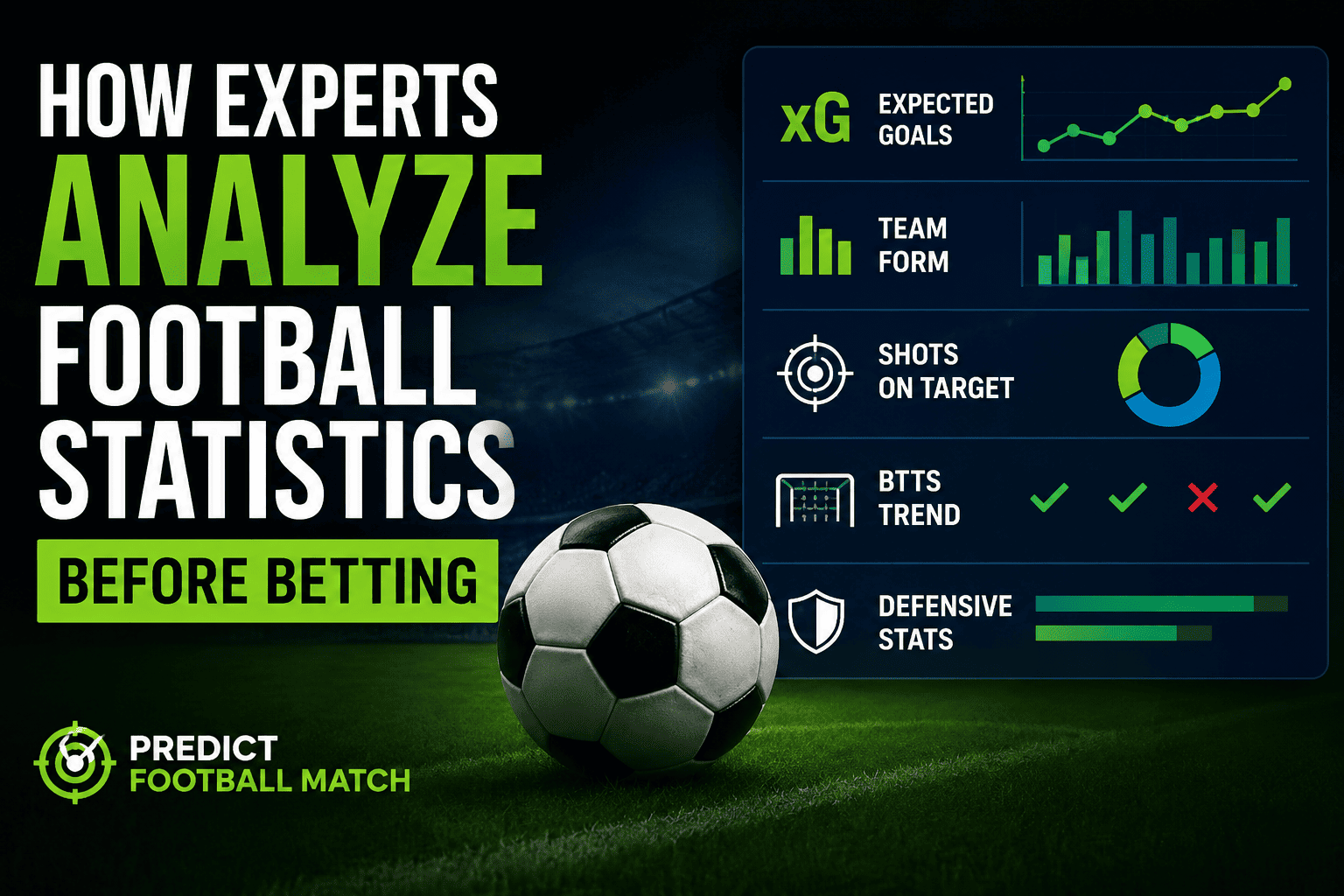
One of the most important ideas in modern football analysis is chance quality. Expected Goals, commonly referred to as xG, measures how likely a shot is to result in a goal based on factors such as location, angle, and defensive pressure.
Experts use chance quality because goals can be misleading in small samples, while chance creation tends to repeat over time. Teams that consistently create good chances usually score more goals over the long run.
Rather than asking how many goals a team scored recently, professionals ask whether the team consistently creates opportunities that lead to goals.
Attacking Pressure and Match Control
Goals often come from sustained pressure rather than isolated moments. Teams that spend more time in the attacking third tend to increase the probability of scoring.
Indicators of attacking pressure include the frequency of shots on target, time spent in dangerous areas, and the ability to force defensive mistakes.
A match where one or both teams apply constant pressure is more likely to produce goals than a game played entirely in midfield.
Defensive Vulnerability Matters More Than Star Attacks
One common beginner mistake is focusing only on strong attacks. Experts pay just as much attention to defensive weaknesses.
Defensive vulnerability may include poor organization, frequent individual errors, and difficulty defending wide areas or set pieces. Many high-scoring matches happen not because attacks are exceptional, but because defenses fail repeatedly.
Why Team Form Is Often Misunderstood
Recent form is useful, but it is also one of the most misused concepts in goal prediction. A single high-scoring match does not necessarily indicate a trend.
Experts approach form by looking at multiple matches instead of one result, identifying repeating patterns rather than extremes, and separating performance from outcome.
A team winning 3-0 with few chances is less convincing than a team drawing 1-1 while creating multiple high-quality opportunities. The process matters more than the final score.
Tactical Context and Match Behavior
Tactics shape how a match unfolds. Playing style, formation, and game plan all influence goal probability.
Some teams naturally encourage open matches through high pressing, quick transitions, and aggressive wide play. Others aim to control space and tempo, which often reduces scoring opportunities.
Experts always consider how two tactical approaches interact, not just how each team plays individually.
Motivation and Match Context
Not all matches are played with the same intent. Motivation can dramatically change match behavior.
Situations that often increase goal probability include teams needing a win to stay in a competition, relegation battles, and end-of-season matches where goal difference matters.
On the other hand, matches where a draw suits both teams often produce fewer risks and fewer goals.
How Experts Choose the Right Goal Market
Once the overall goal potential of a match is understood, experts then decide how to approach it.
Some matches require a broad view of goal activity. In these cases, a structured total goals analysis is appropriate: How to Predict Total Goals in Football Using Statistics .
Other matches show clear signs of attacking momentum and defensive weakness. When the game environment supports open football, Over goal markets become more relevant, particularly Over 2.5 goals: How to Predict Over 2.5 Goals Using Statistics .
There are also matches where goals are expected, but within a controlled range. These fixtures often suit goal range markets: Goal Range Prediction Explained (1–2, 2–3, 2–4 Goals) .
The key point is that experts adapt the market to the match, not the other way around.
Common Mistakes Beginners Make When Predicting Goals
- Overreacting to recent scorelines
- Ignoring defensive data
- Treating odds as probability
- Betting too many matches instead of filtering carefully
Experts avoid these mistakes by remaining selective and process-driven.
Putting It All Together: The Expert Mindset
Expert goal prediction follows a simple mindset:
- Understand how goals are created
- Evaluate attacking and defensive behavior
- Consider tactical and motivational context
- Choose the market that fits the match
The goal is not to predict every game, but to identify the right opportunities and ignore the rest.
Where to Go Next
If you want to go deeper, explore these detailed guides:
Final Thoughts
Football goal prediction is not about certainty. It is about probability, discipline, and understanding how matches behave over time. By focusing on data, context, and patterns rather than emotions, you put yourself in a position to make smarter decisions.
Master the process first. The markets come second.